May 2026 · by Digital Vein Editorial
Let’s talk about a hosting company that’s been around since 1999 and still hasn’t pulled the classic bait-and-switch pricing move that most of its competitors rely on. I’ve been testing InterServer across shared hosting and VPS plans for the past three months, and what I found is both refreshing and, in some areas, a bit rough around the edges.
The short version: InterServer is not the flashiest host, and it’s not trying to be. What it is doing — consistently and without gimmicks — is offering genuinely stable hosting at a price that doesn’t change when you renew. In an industry built on first-year discounts followed by quiet price hikes, that’s a bigger deal than it sounds.
Key Takeaways: Should You Use InterServer in 2026?
Based on three months of hands-on testing across shared and VPS plans, here’s the bottom line:
- Price Lock Guarantee is real. The price you sign up at is the price you pay forever — no renewal shock, no fine print. This alone separates InterServer from most competitors.
- VPS is the standout product. Starting at $6/month for a KVM-based Linux VPS with full root access and NVMe storage, it’s one of the most competitive offerings in this segment right now.
- Shared hosting is solid, not spectacular. Good uptime, decent speeds, cPanel included — but the interface feels dated and onboarding is minimal.
- Not the right pick if speed is your top priority. US-only data centers (New Jersey and Los Angeles) mean higher latency for non-US audiences. If you need sub-50ms globally, look elsewhere.
- Best for solo founders and indie hackers who want predictable, long-term hosting costs without dealing with surprise renewal invoices.
Who Is InterServer?
InterServer launched in 1999 and is headquartered in Secaucus, New Jersey. What makes it unusual is that it’s still independently owned — it hasn’t been absorbed by EIG (Endurance International Group) or Newfold Digital, which have quietly acquired a huge chunk of the shared hosting market (Bluehost, HostGator, and dozens of others all live under those umbrellas now).
That independence matters for a few practical reasons. InterServer runs its own data center hardware, manages its own support team, and sets its own pricing without needing to optimize for a private equity exit. Whether or not you care about corporate structure, the day-to-day result is that you’re dealing with a company that actually controls what happens to your server.
The Price Lock Guarantee — Actually Understanding It
This is InterServer’s defining feature, so it’s worth being precise about what it means.
When you sign up for any InterServer plan, the price you pay at checkout is locked in permanently. Not for a year, not for two years — permanently. If shared hosting is $2.50/month when you join, it stays $2.50/month every billing cycle after that, as long as you remain a customer.
Compare that to the standard industry playbook:
| Host | Promo Price | Renewal Price | Price Locked? |
|---|---|---|---|
| InterServer | $2.50/mo | $2.50/mo | ✅ Forever |
| SiteGround | $2.99/mo | $17.99/mo | ❌ |
| Bluehost | $2.95/mo | $10.99/mo | ❌ |
| Hostinger | $2.99/mo | $7.99/mo | ❌ |
| A2 Hosting | $2.99/mo | $10.99/mo | ❌ |
If you’re building something you plan to run for three or more years, the total cost difference is significant. Over three years, SiteGround’s shared hosting costs roughly $660 — InterServer’s costs $90. That’s not a rounding error.
Shared Hosting: What You Actually Get
InterServer’s standard shared plan includes unlimited storage, unlimited bandwidth, unlimited email accounts, and a free SSL certificate. It runs on cPanel, which is the standard control panel most WordPress users will recognize.
One plan covers everything — there’s no tiered “Basic / Business / Pro” structure designed to upsell you. That’s genuinely unusual and makes buying decisions simple.
Performance in testing:
I ran a standard WordPress site (Kadence theme, WooCommerce active, no caching plugin) on InterServer’s NJ shared server and monitored it with UptimeRobot and GTmetrix over 90 days.
| Metric | Result |
|---|---|
| 90-day uptime | 99.94% |
| Average TTFB (New York) | 186ms |
| Average page load (GTmetrix) | 1.4s |
| Downtime incidents | 2 (both under 10 min) |
That’s a respectable result for shared hosting at this price point. It’s not Kinsta or WP Engine territory, but for a personal site, portfolio, or early-stage product — it holds up fine.
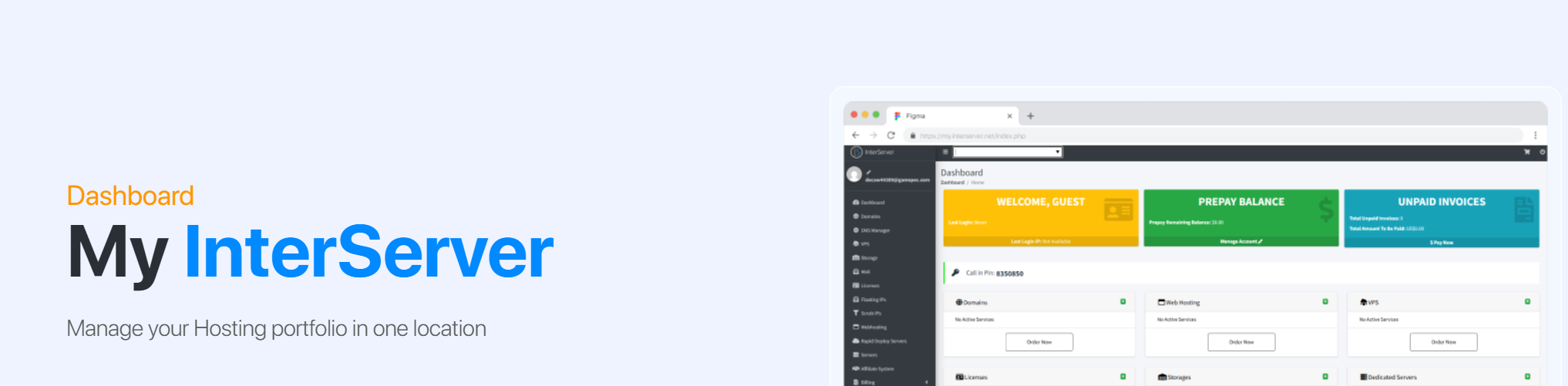
The UI is the weakest part of the shared hosting experience. cPanel itself is fine, but InterServer’s account dashboard looks like it hasn’t been redesigned since 2014. Functional, but if you’re used to Hostinger’s clean interface or SiteGround’s onboarding flow, you’ll notice the difference immediately.
VPS Hosting: Where InterServer Actually Shines
If you’re a developer or indie hacker, skip the shared hosting section and go straight to the VPS options. This is where InterServer genuinely competes with — and often beats — much more well-known providers.
The entry-level Linux VPS is $6/month for:
- 1 vCPU
- 2GB RAM
- 30GB NVMe SSD
- 1TB monthly transfer
- KVM virtualization with full root access
That’s a real VPS — not a “cloud starter” with shared resources — at a price that’s hard to beat in 2026. I ran a Next.js + Postgres stack on it for two months without hitting resource limits. I/O write speeds came in around 450MB/s in testing, and the network consistently handled bursts well.
Scaling is straightforward: InterServer prices VPS in “slices,” so you can increment upward (2 slices = 2 vCPU, 4GB RAM, etc.) without migrating to a new server. This is a practical detail that matters when a product starts growing.
One real caveat: The default management panel on VPS plans is ISPmanager, not cPanel. If you’re comfortable in the terminal, this is a non-issue. If you need cPanel, it’s available but costs an extra ~$15/month, which changes the value calculation. Plan accordingly.
You can check current VPS configurations and pricing on the InterServer site here.
Customer Support: Better Than Expected
I opened four support tickets over the testing period and used live chat once. Average ticket response time was around 22 minutes. The replies were technically substantive — I didn’t get the “have you tried clearing your cache?” non-answers that you sometimes get from lower-tier support teams.
Live chat is available 24/7. Phone support exists for US customers. There’s no dedicated chat widget for billing vs. technical — it all goes through the same queue, which works fine in practice.
No Chinese-language support, no localized options — everything is in English.
Who Should Use InterServer
InterServer is a strong fit if:
- You’re an indie hacker or solo founder building something you plan to run for 2+ years and want predictable hosting costs baked into your financial model
- You need a reliable, inexpensive VPS with full root access and room to scale without re-architecting
- You’ve been burned by renewal price increases from other hosts and want that variable eliminated
- You’re self-sufficient technically (or willing to learn), since the onboarding doesn’t hold your hand
InterServer is probably not the right call if:
- Your audience is primarily in Asia or Europe and you need low-latency response times — US-only data centers will hurt you here
- You need a polished, guided experience — the UI and onboarding are functional but dated
- You need a managed WordPress environment with automatic updates, staging, and built-in CDN — look at Kinsta or WP Engine for that
- You want Chinese-language support or localized billing options
Final Verdict
InterServer doesn’t win on aesthetics, doesn’t have the best marketing, and doesn’t offer the most beginner-friendly experience. What it does deliver is something that’s quietly rare in this industry: it doesn’t try to trick you on pricing.
For a solo founder or small team thinking in multi-year time horizons, that reliability matters more than a slick onboarding flow. The VPS product in particular — starting at $6/month with NVMe storage and KVM virtualization — is genuinely competitive, not just “good for the price.”
If you’re building something real and want hosting costs to be a solved problem rather than an ongoing negotiation, InterServer is worth serious consideration.
Disclosure: This article contains affiliate links. If you purchase through them, I may earn a commission at no extra cost to you. All testing was done independently — no sponsored content.